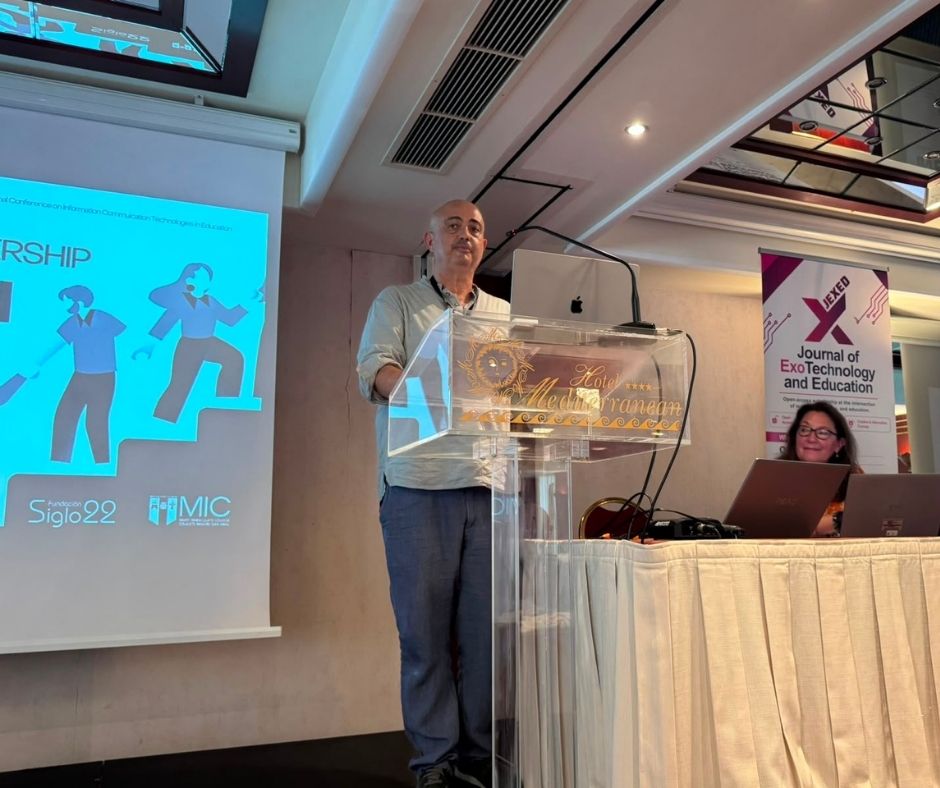
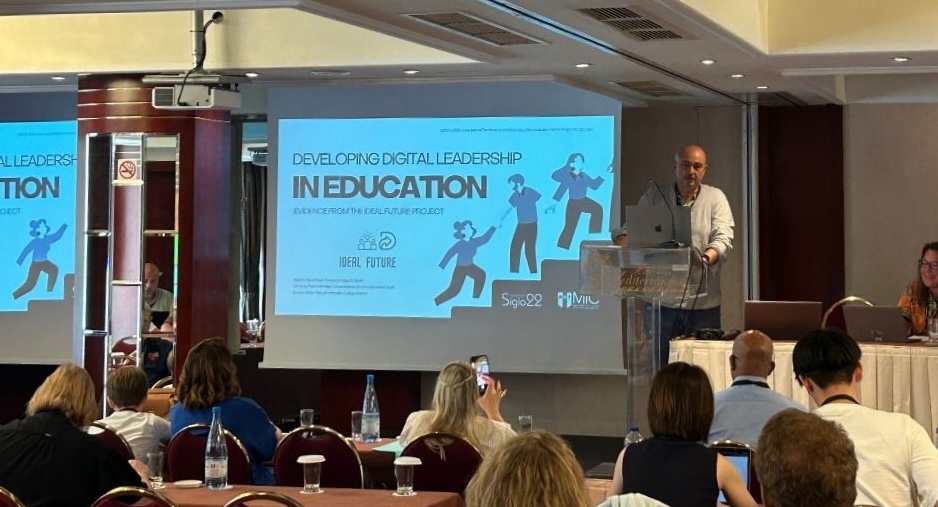
The presentation, entitled “Developing Digital Leadership in Education: Evidence from the IDEAL Future Project”, was delivered by Mariano Sanz Prieto from Fundación Siglo22, Gema de Pablo González from Universidad Autónoma de Madrid, and Emma O’Brien from Mary Immaculate College, Ireland. Together, they shared the main evidence collected during the first stages of the project.
Digital leadership: a key challenge for educational transformation
The presentation highlighted that digital transformation has become a strategic priority for schools and universities. However, research and competence frameworks have traditionally focused mainly on teachers, while the role of educational leaders has received considerably less attention.
IDEAL Future was created to address this gap by exploring the challenges faced by school and institutional leaders and identifying the competences they need to guide meaningful, inclusive and sustainable digital transformation.
A European project grounded in evidence
IDEAL Future brings together organisations from Spain, Ireland, France, Greece and Latvia to develop an evidence-based model for digital educational leadership.
The project focuses on two main areas. The first examines the experiences, challenges and competence needs of educators and leaders navigating digital transformation. The second explores the professional-learning approaches and conditions that are most effective in developing digital leadership.
The research uses a mixed-methods approach combining qualitative depth and quantitative reach. It includes 164 semi-structured interviews, responses from more than 500 education professionals, and evidence gathered across four European countries.
The main challenges of digital leadership
The findings show that digital transformation is not simply a technological issue. Educational leaders described it as a strategic, cultural and human process involving the whole organisation.
The main challenges identified include gaps in staff digital competence and confidence, unequal access to technology, digital wellbeing, the ethical use of artificial intelligence and data, resistance to change, and limited confidence in areas such as digital strategy, procurement and preparation for AI.
The research also underlines that innovation cannot depend on isolated individuals. Sustainable transformation requires shared ownership, collaboration and the active involvement of the entire educational community.
What competences do digital leaders need?
The project identified several leadership competences considered especially important for supporting digital transformation.
These include the ability to create a clear and shared vision, develop a culture of learning, design an effective digital strategy, understand digital culture and its impact, support digital inclusion and diverse needs, and build strong relationships across the educational community.
These results reinforce the idea that digital leadership goes far beyond technical knowledge. It also requires strategic thinking, communication, collaboration, ethical awareness and the ability to manage organisational change.
How should educational leaders be supported?
One of the central messages of the presentation was that one-off training workshops are not enough to develop effective digital leadership.
The research shows that professional learning is most effective when it is collaborative, practical, personalised and sustained over time. Participants valued peer learning, communities of practice, mentoring and coaching, practice-based learning and opportunities to work on authentic challenges from their own professional contexts.
Although formal workshops remain a popular option, the data also reveal strong interest in peer discussion, practice sharing, team teaching, study visits, work-based learning and collaborative projects.
From research evidence to five design principles
The findings from the research have been translated into five principles that will guide the IDEAL Future professional-learning model.
The model will be:
- Competency-focused, responding to identified digital competence gaps.
- Autonomous, allowing flexible and personalised learning choices.
- Sustained, providing ongoing support in response to rapid technological change.
- Continuous, encouraging reflection and professional development over time.
- Multifaceted, combining different learning formats and communities of practice.
The IDEAL Future Digital Hub
These principles will be put into practice through the IDEAL Future Digital Hub, a professional-learning ecosystem designed to support educational leaders at individual, organisational and inter-organisational levels.
The Hub will include competence self-assessment, personalised learning pathways, reflective practice, collaborative learning and mentoring, and challenge-based activities. Its purpose is to help leaders navigate the pedagogical, organisational, ethical and technological dimensions of digital transformation.
Fundación Siglo22’s commitment to educational innovation
Fundación Siglo22’s participation in ICICTE 2026 reflects its commitment to developing innovative and evidence-based solutions that help educational institutions respond to digital change in a strategic, inclusive and sustainable way.
The evidence presented at the conference represents an important step towards the creation of the IDEAL Future Digital Leadership Framework and the development of practical resources for current and future educational leaders across Europe.
The next stage of the project will focus on implementation and evaluation, examining how leaders engage with the framework and Digital Hub and how their competences develop over time.