What is it?
This certification was developed by the IDEAL Futures Teacher Academy to recognise teachers and school leaders who take part in professional learning aligned with the DigCompEdu framework.
To earn the certificate, you need to complete 250 hours of learning through specific courses. Once finished, email us to request your certificate.
Why does it matter?
This certification gives Teacher Academy participants an independent, Europe-wide recognised certificate. It supports career progression and makes it easier to work across different countries.
Importantly, the certificate is technology-neutral (not linked to any company) and helps European governments meet national targets. For example, Spain aims for 80% of teachers to be digitally certified.
How do I become certified?
- Register on the digital hub here
- Click on Certification
- Select European Certified Digital Pedagogical Leader.
- Complete 10 courses of the 17 courses listed (250 hours of coursework)
- After you have completed Email the responsible of your country to become a European Certified Digital Pedagogical Leader.
After that, you can progress to European Certified Educational Leader by completing another 250 hours of learning, this time focused on leading whole-school and cross-institutional digital integration.
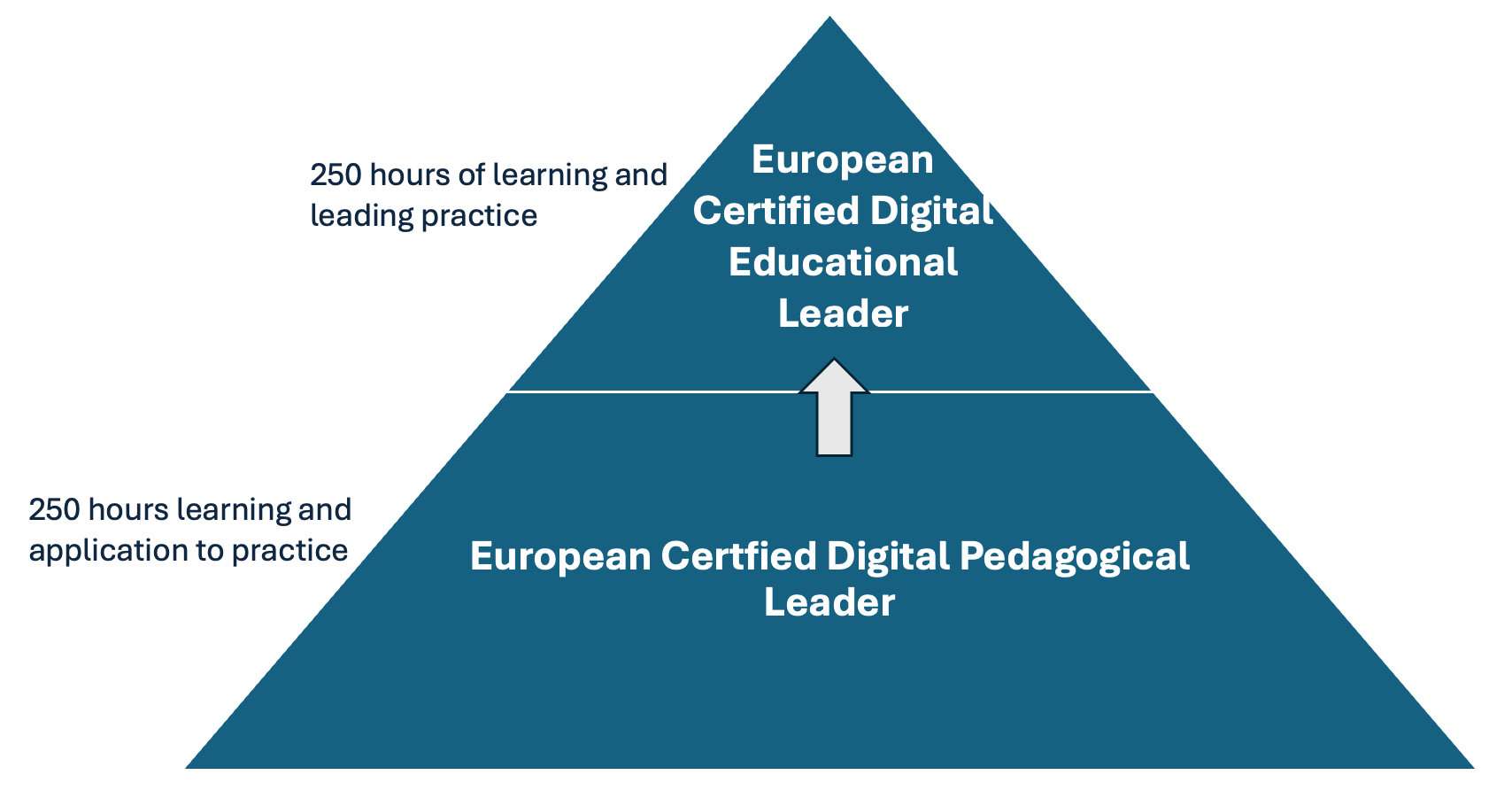
What do I need to become a European Certified Digital Pedagogical leader?
Who is it for: teachers or educators that wish to become more proficient or progress into pedagogical leadership roles in their own contexts, leading innovative digital pedagogical practice in their organisations.
Prior experience: No prior experience is required.
Courses available: For this certification there are 17 self study courses available or 6 micro credits.
Required completion: Participants will have to complete 10 of these (or 250 hours of learning and applying to practice) or two micro credits.
Courses are listed below per competencies:
- Professional engagement
- 1.1. Organisational communication
- 1.2. Professional Collaboration
- 1.3. Reflective practice
- 1.4. Digital Continuos and professional development
- Digital resources
- 2.1. Mastering digital resource selection and implementation in education
- 2.2. Fundamentals of digital resource creation, modification, and AI integration in education
- 2.3. Managing, securing, and strategically implementing digital resources and AI in education
- Teaching and learning
- 3.1. Digital teaching and learning in an age of emerging technologies
- 3.2. Supporting learners in a digital environment within and beyond the classroom
- 3.3. Collaborative and Human Centred approaches to digital learning
- 3.4. Supporting self regulated learning and learner agency through digital technologies
- Assessment
- 4.1. Assessment strategies
- 4.2. Analysing evidence
- 4.3. Feedback and planning
- Student empowerment
- 5.1. Supporting inclusion using current and emerging technology
- 5.2. Personalising learning using technologies
- 5.3. Using technology to actively engage learners
What do I need to become a European Certified Digital Educator?
Who is it for: tdigital pedagogical leadership roles or leadership roles to enable them to collaborate with other schools, technology companies, engage in inter organisational research at national and international level.
Prior experience: European certified Digital pedagogical leadership required.
Courses available: For this certification there are 17 self study courses available or 6 micro credits.
Required completion: Participants will have to complete 10 of these (or 250 hours of learning and leading practice) or two micro credits.
Courses are listed below per competencies:
- Professional engagement
- 1.1. Leading Digital organisational communication
- 1.2. Leading Professional Collaboration through technology
- 1.3. Leading technology based reflective practice
- 1.4. Leading Digital Continuous and professional development
- Digital resources
- 2.1. Strategic implementation of digital resources
- 2.2. Mastering complex collaborative development of digital resources
- 2.3. Strategic leadership in digital resource publishing and protection
- Teaching and learning
- 3.1. Designing and Leading teaching and learning using emerging technologies
- 3.2. Investigating the use of emerging technologies in supporting learners inside and beyond the classroom
- 3.3. Designing and leading Collaborative and Human Centred approaches to digital learning
- 3.4. Designing and evaluating self regulated learning using digital technologies (Leadership)
- Assessment
- 4.1. Leading assessment strategies using emerging technology
- 4.2. Designing strategies to analysing evidence using emerging technologies
- 4.3. Strategic Feedback and planning using emerging technologies
- Student empowerment
- 5.1. Leading inclusion using current and emerging technology
- 5.2. Designing personalising learning environments using emerging technologies
- 5.3. Strategic approaches to actively engage learners using emerging technologies